MapBrief™

Geography · Economics · Visualization

Open Government is a Slammed Door at the BLM

So maybe having easy access to natural gas lease polygons in Sublette County, WY isn’t a priority for you.  But if phrases such as “open government”, “open data”, “energy independence”, “stewardship of federal lands”, or “government transparency” resonate even a little bit, then what’s going on now at the BLM with the National Integrated Land System (NILS) GeoCommunicator project should concern you.  Because it’s an object lesson in what pretty phrases are the first to be slayed when a large federal agency and a dominant geospatial vendor bollix up a high-profile public web mapping initiative.

Back in May the BLM started to remove key spatial layers from GeoCommunicator:  mining claims, oil and gas leases, rights-of-way etc.  What’s interesting is the reason given for removal wasconcerns of data quality.” Specifically, the spatial boundaries being derived from the legal descriptions stored in the agency’s database of record (LR2000), were not accurate. Now the BLM is also the caretaker of  geographic coordinate database (GCDB) that represents the federal government’s version of the Public Land Survey System (PLSS).  So if there are data quality issues in how textual legal descriptions are being converted in the geospatial boundaries, then the problems here aren’t trivial and speak to fundamental mis-steps in data management and internal QA/QC.

BLM GeoCommunicator Oil & Gas Leases

Halcyon days: remixing GeoCommunicator Oil & Gas lease boundaries and web services in Google Earth


Now as someone who uses, modifies, and re-sells GeoCommunicator data to the Oil & Gas industry, I’m far from a disinterested observer.  So when I spotted a colleague from the BLM at a recent social gathering, I naturally wanted to chat him/her up for an update as to what was going on.  The response:

We’re literally not allowed to talk about it.

No longer are we talking simply about a website being down, but something that apparently requires BLM management to impose a mafia-like omerta on its own people. I understand institutional arse-covering, except for the inconvenient fact we’re talking about taxpayer money.

How much money are we talking?  Back in 2001 when the GAO was documenting that BLM’s shortcomings in mismanaging the $411 million ALMRS project, mention was made of NILS forecasted cost being $16.7 million.  Flash forward to 2007, and we see that NILS tab listed at $36.2 million: but this is the proverbial visible tip of the iceberg as those more proximate to the situation speculate the current accumulated tab being closer to a 9-figure sum.  (By the way, in the same document, Geospatial One-Stop–another spatial web initiative–weighs in at $57.9 million…). Unfair it would be to the large number of savvy GIS professionals working at the BLM not to point out the good work in primary data collection and analysis being done, particularly at the state-office level (which has been picking up the slack in data provisioning while GeoCommunicator has been down). But these big, hairy, heavy agency-wide IT initiatives have been, and continue to be, sources of very expensive grief.

Equally unfair would be to omit mention of ESRI: for every mis-managed, cost-overrun step of the way they are pocketing good taxpayer cash.  As the dominant geospatial vendor in the US, their skill in landing the biggest of the Federal GIS contracts goes hand-in-hand with a marketing machine equally adept at churning out frequent dispatches of glossy self-regard. But what of these pricey taxpayer-funded projects that go pear-shaped (GeoCommunicator) or, more commonly, simply don’t deliver a compelling ROI to the public (Geospatial One-Stop)? Reading between the lines, with the BLM saying next-to-nothing but managing to reference “data quality”, one imagines a metaphorical index finger pointed at Redlands.  Just supposition, but the larger frustration to the end-user/taxpayer is the lack of mechanisms for accountability in the agency-vendor relationship.  Such opacity leads to a certain skepticism when the big vendors/federal contractors bang the drum for a “national GIS”: this 2009 proposal by ESRI and Booz-Allen put forth an ambitious (or grandiose) integration plan for federal, state, and local GIS assets for a tidy $1.2 billion.  Top-down, large scale spatial-data-integration-by-directive simply doesn’t have the track record of success to justify the costs, especially in view of how users actually search for and interact with information on the web (hint: search engines, not portals).

Perhaps GeoCommunicator will magically come back to life next week, with a rich interface and maybe even a REST api. But the off-putting behavior of the BLM is of a piece with a larger suspicion that the recent enthusiasm for open data/open government at the federal level has petered out. At the very least, the misty idealism of the open gov movement–bringing closer together citizens and the government designed to serve it–has failed to take into full account the much more intimate relationship between federal agencies and the quite tangible interests of its largest IT vendors.


—Brian Timoney

Google Earth and the Quagmire of Enterprise IT

With Google Earth marking the 6th anniversary of its launch this month, the news that they’re going to throw their hat in the ring of enterprise data management has elicited some enthusiasm but also well-wishing.  As in, “good luck with that.”

In a confluence that comes from too much web surfing, I saw the Directions Magazine Google Earth Builder webinar on the same day that Paul Ramsey pointed me to “Why businesses move to the cloud: They hate IT.”  I made an analogous argument over a year ago: IT is suffocating GIS.  Simply put, too many resources within GIS departments are devoted to sys admin tasks, database tuning, etc., instead of focusing on data accuracy, cartography, and spatial analysis.  To be sure, this state of affairs benefits vendors collecting annual licensing fees:  a colleague in Oil & Gas mentioned paying for three ArcServer licenses despite not having a chance “to play with it” yet.

In important respects, Google Earth has always been “enterprise–ready” via the KML file format where with the <NetworkLink>  and <Region> tags one can stream dynamically large corporate data stores all the day long.  Add to the mix that both standard versions of Oracle and SQL Server ship with enough geospatial functionality for basic distance analysis and choropleth mapping and one can argue that with a little elbow grease, and a degree of internal coordination, much can be done with tools already in place.

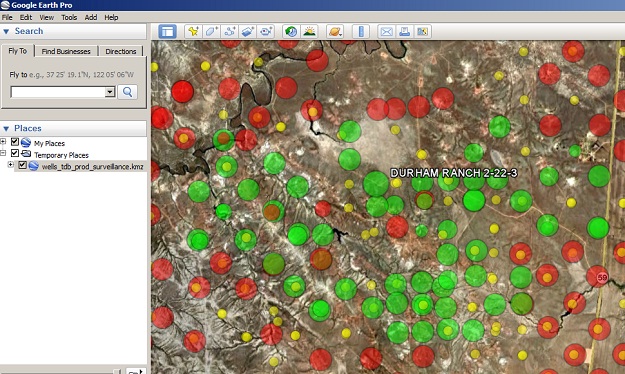
Google Earth streaming dynamic data

Fortune 500 Oil Company With Squared-Away IT Streams Oil & Gas Production Data Straight From Oracle


But the internal coordination piece is the gotcha:  technology is easy, it’s the anthropology that’s difficult. Nothing against human beings, but taking people out of the equation of organizational data flow is the biggest lure of Cloud platforms.

Can Google Earth Builder be successful?  Sure:  the big Federal agency contracts, the larger states, and the major extractive industries players can deliver the required returns.  As for the medium- and small-fry, the more GIS-centric Cloud offerings from Arc2Earth and WeoGeo probably make more sense.   Whatever the case, Google’s best hope lies not with the self-styled “visionary”  CTO/CIO but rather those all too aware of the inertia and silo-ed intransigence inside their own organizations.


—Brian Timoney

Halford Mackinder and the Urgency of Geography

Halford Mackinder, geography’s eminent Victorian, is enjoying a sort of moment on the occasion of the 150th anniversary of his birth.  Explorer, professor, and parliamentarian, Mackinder is most well know for his seminal article The Geographical Pivot of History that described the centrality of eastern Europe in exerting geopolitical power around the world.  Frankly meditating on the power of Empire and the posthumous association of his ideas with Nazism relegated Mackinder to a dusty, slightly disreputable corner of academic geography where one referenced his work only with a ready supply of air quotes.  With the recent neoconservative focus on distant threats to American power, he is once again name-checked to lend intellectual ballast to schemes for ensuring top-dog status in a uni-polar world.

But that’s not the Halford Mackinder that interests me.

Instead it’s the Mackinder that travelled 30,000 miles around the UK over three years promoting a “New Geography” as an academic pursuit at all grade levels.  What he saw was geography’s unique ability to build synthesize and create context among the ever more specialized physical and social sciences.  And this was 125 years ago: what would he make of the deluge of narrow facts we navigate today?

We live in a swirl of data but we understand the world around us through stories.  As nature abhors a vacuum, humans will reach for whatever narrative framework is most handy, no matter how dubious, to make sense of the chaos of information that bombards them daily.

And this is the urgency:  we’ve never been in more need of robust frameworks to process data into narrative, or a “persistent context”.  Reflecting back on his efforts in Geography as a Pivotal Subject in Education, Mackinder admits geography never gained the hoped-for foothold.  Almost 100 years later, the academic presence of geography in the US is, if anything, more feeble.  But hope blossoms: with the explosion of digital mapping, both through interfaces such as Google Earth as well as in the media, geography and visual understanding are increasingly linked in the popular mind. And given the turbulence in education, there seems ample opportunity to lay a new foundation for a more prominent, analytic geography throughout the curriculum.

It’s too easy to dismiss the crusty Victorians of yesteryear, but Halford Mackinder’s deep conviction that geography is a critical component of an educated mind resonates loudly in an ever-baffling world about which we can’t stop telling stories.


—Brian Timoney