MapBrief™

Geography · Economics · Visualization

Political Hypocrisy & Economic Ignorance: the Case Against Atanas Entchev

This week many of us in the geospatial community have been deeply troubled by news that our colleague Atanas Entchev, along with his wife and son, have been detained by the Immigration and Customs Enforcement (ICE) at a for-profit “Community Education Center” (read: prison) in Newark, New Jersey.  Prominent in the online world with his blog, articles in professional publications, and reliably droll tweets, I enjoyed meeting up with him when on the East Coast for wide-ranging conversation over lunch, comparing notes on the life of freelance GIS consultant.  Among others, John Reiser, James Fee, Adena Schutzberg, and Bill Dollins have helped spread the word about Atanas’ plight and the support fund set up for his family.

It's a lot of things, but certainly not "justice": US Government is spending your tax dollars to deport law-abiding immigrant entrepreneurs in order to meet internal quotas.


A native of Bulgaria, Atanas came to the US in 1991 in the wake of the turmoil in Eastern Europe following the disintegration of the Iron Curtain, etc.  The winding road of the 20-year legal saga can be found here. To a layman, it reads as a story of differing interpretations of perceived threat in a chaotic political climate and a litany of motions, counter-motions, and paperwork deadlines.  Amid these gray areas of interpretation, there is no accusation of any type of criminal behavior on the part of Atanas or his family members during their 20-year stay here. Given that Atanas became firmly established professionally and his family lived the life of the educated middle-class, the question of “why deportation now?” lingers.

By coincidence, Frontline this week is broadcasting a feature, ‘Lost in Detention’, outlining the increasingly aggressive measures to deport immigrants.  The key clip begins at the 17-minute mark outlining the arbitrary goal of 400,000 deportations, including “Non-criminal removals”. So like school test scores and police CompStat metrics, deportation goals seemingly have unleashed their own set of nasty counter-productive consequences.  And is it any wonder in our time of federal budget cutbacks that agencies re-double efforts to protect their slice of the pie, invoking “security” whenever possible?  Further, with an election year coming up, neither party wants to be seen as anything but tough on immigration, happily playing on the fears of economically downtrodden voters.

But here’s the funny thing about immigration:  economically, it’s a net positive.  And when you’re talking educated professionals fluent in the language with an entrepreneurial bent it’s utterly self-defeating to turn them away. In our time of expending trillions in the hopes of stimulating the economy, that the inarguable financial benefits of immigration can’t be acknowledged speaks volumes either of the ignorance or moral cowardice of the political class.  Hell, even Tom Friedman gets it.

Having little faith in the efficacy of appealing to the better nature of politicians, I would nonetheless urge you to, in addition to the methods of support listed above, drop a line to Atanas’ Senate and Congressional representatives asking why taxpayer money is being wasted on imprisoning a non-criminal immigrant entrepreneur and his family members–

                     Congressman Frank Pallone (Atanas’ office is in his district)
                     Senator Frank Lautenberg
                     Senator Robert Menendez

 
Like so many whose formative years were spent elsewhere, Atanas is notably well-mannered: I’m utterly confident that whatever effort you can expend on his behalf would earn a lifetime of gratitude.

—Brian Timoney

Web Mapping Continues to Pay for the Sins of Internet Explorer

So how have you been celebrating the 5th anniversary of the launch of Internet Explorer 7? For tens of thousands of public sector folk here in the US, they celebrate everyday as IE 7 is the only browser they are allowed to use on the job*. For comparison’s sake, the best-selling mobile phone in 2006 was the Nokia 1600. Now imagine if every mobile app had to be backwards compatible with the most popular cellphone of 2006?

And now you being to understand the rage web developers feel towards Internet Explorer versions 6-8 and the thousands of programming hours spent weekly accommodating their quirks and the 20-25% market share they continue to hold on to in 2011.  And knowing that the more standards-compliant alternatives, Firefox, Chrome, and Safari, are freely downloadable makes the despair all the more wail-inducing.

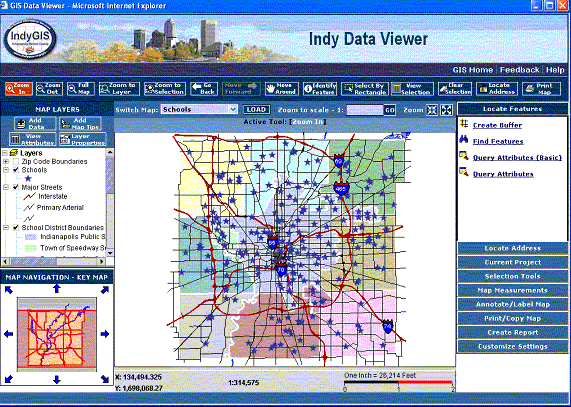
         Contemporary web mapping continues to be haunted by the GIS-in-a-browser approach


The cool kids, of course, don’t give a thought to those left behind in IE-land and happily embrace the HTML5 future. But we in the mapping world have no such luxury as the very entities most likely to be using retrograde browsers are the traditional users of GIS (read: guv’ment). So there was a big embrace of Flash and Silverlight plugins as cross-browser “solutions”, whose viability ended when Apple decreed no plugins on the iPhone and iPad. The inside joke is that “RIA”, the self-designated acronym for “Rich Internet Application” now stands for “Rich Intranet Application.”

Now let’s indulge in a bit of counter-factual fantasy: it’s August, 2001 and Microsoft announces the launch of Internet Explorer 6 that will support Scalable Vector Graphics (SVG), a W3C standard for drawing vectors in the browser using ordinary mark-up inside an HTML page. Because of performance limitations, the maps made with SVG are limited in the number of features displayed, but nonetheless we start seeing lots of choropleth (thematic) maps especially on election night. Further, the visibility of SVG mark-up via the trusty “View Source”  command enables non-programmers to copy professional examples and make their own web pages with custom maps. Personal online diaries, subsequently called blogs, start embedding their own maps and the democratization of cartography gathers even more momentum.

None of this happened.

Instead, Microsoft foisted its own preferred standard–VML–and web mapping remained strictly the province of “heavy” server-centric solutions until Google Maps and the mashup revolution kicked off in 2005. With its predilection for over-engineered GIS-inside-a-browser apps, the industry combined evolving server resources with plugins (Flash, ActiveX, Silverlight) to push large volumes of both raster and vector data via interfaces that even today way too many users find bewildering. A side-effect of the industry embracing complex apps is that in too many shops, web mapping became the province of the hired consultant, with the GIS Analyst shunted aside for lack of programming chops. Recent online make-a-map services such as GeoCommons, Google Fusion Tables, and ArcGIS Online are a much-needed re-empowerment of the non-programming web mapper.

In future posts I’ll highlight two new-ish mapping approaches to bridge the worlds of Internet Explorer and the iPad:  MapBox and Raphael.js. But in the meantime, while the techno-optimists invoke William Gibson and a future that’s already here, just unevenly distributed, I fear we in the geospatial realm are more haunted by William Faulkner’s observation that “the past is never dead. It’s not even past.”

 
—Brian Timoney

*Currently the case with my beloved City & County of Denver.  Colleague Bill Dollins speaks of DoD shops still using IE 6. Quelle horreur.

Among America’s Best & Brightest, Geography Casts But a Faint Glow

Proust had his madeleine, the rest of us have our parents’ basements and attics with the bric-a-brac that promises emotional transport to a different time and place. During my last visit home, I came across my grandmother’s diploma circa 1914: a fascinating document from an era where a couple years of high school was the terminus for her social class and a quite adequate preparation for being a seamstress, clerk, or housewife (the professions of her and her sisters).  Most interesting, the diploma listed the courses she took: catching my professional eye were entries for both Physical Geography and Political Geography.

In other words, two more geography courses than her grandson took in his “college prep” curriculum seventy years later.

Being curious as to what the kids are up to today, I delved into the Advanced Placement (AP) test data for 2011 to find out “whither Geography among our best and brightest?”  While the rigorous International Baccalaureate curriculum has gained traction in recent years, AP courses are more numerous and their test scores, which can command college credit, provide a hefty sample size from which to draw conclusions.


The good news?  Among subjects with more than 50,000 test-takers, Human Geography had the largest year-over-year increase with a healthy 22.6% bump to almost 84,000 students undergoing the 2-hour ordeal.

The bad news?  More than twice as many young American minds sat for the AP Psychology test.

(Editor’s note: pondering for more than 30 seconds what may lurk inside a high school Psychology text book plunges the author into existential despair.)

But that’s not the worst news. Because on a scale of one to five, over 31% of those taking the exam scored a “1” i.e. utter failure. Adding to the ignominy, a bare majority of 51% scored a passing grade of 3, 4, or 5.


Taking a closer look at the scores and their distributions, one can make the broad claim that results in the social sciences are fairly mediocre.  To be sure there is a selection bias at work as well: completing the coursework for Calculus BC implies mastery of the material in Calculus AB, and the scores reflect that very few bumble through that progression.  (Full disclosure: I was one of those bumblers racking up a “2” in AP Biology many moons ago.)

Cause for hand-wringing despair?  Maybe not.  More plausible to me is the suspicion that for those taking AP Human Geography as a junior or senior in high school, it’s most likely their first exposure to thinking geographically in any kind of a structured manner. If anything, it’s a call for more rigorous geography at all grade levels as analyzing one’s place in the world and the interrelationships with those near and far is too important to leave to a cram course at the end of high school.

Add that to the wisdom lost from back in Grandmom’s day that we so need to recover, 100 years later.

 
—Brian Timoney