MapBrief™

Geography · Economics · Visualization

Among America’s Best & Brightest, Geography Casts But a Faint Glow

Proust had his madeleine, the rest of us have our parents’ basements and attics with the bric-a-brac that promises emotional transport to a different time and place. During my last visit home, I came across my grandmother’s diploma circa 1914: a fascinating document from an era where a couple years of high school was the terminus for her social class and a quite adequate preparation for being a seamstress, clerk, or housewife (the professions of her and her sisters).  Most interesting, the diploma listed the courses she took: catching my professional eye were entries for both Physical Geography and Political Geography.

In other words, two more geography courses than her grandson took in his “college prep” curriculum seventy years later.

Being curious as to what the kids are up to today, I delved into the Advanced Placement (AP) test data for 2011 to find out “whither Geography among our best and brightest?”  While the rigorous International Baccalaureate curriculum has gained traction in recent years, AP courses are more numerous and their test scores, which can command college credit, provide a hefty sample size from which to draw conclusions.
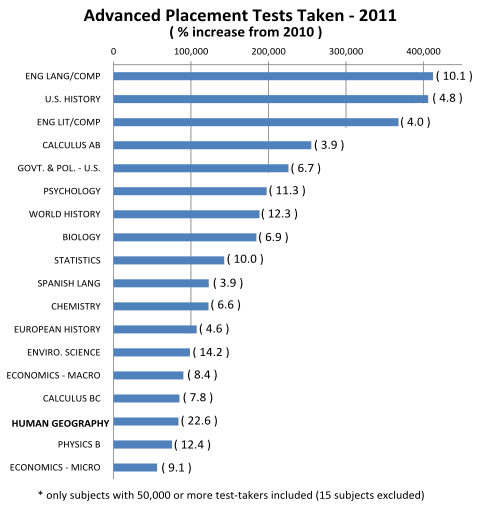
 

The good news?  Among subjects with more than 50,000 test-takers, Human Geography had the largest year-over-year increase with a healthy 22.6% bump to almost 84,000 students undergoing the 2-hour ordeal.

The bad news?  More than twice as many young American minds sat for the AP Psychology test.

(Editor’s note: pondering for more than 30 seconds what may lurk inside a high school Psychology text book plunges the author into existential despair.)

But that’s not the worst news. Because on a scale of one to five, over 31% of those taking the exam scored a “1” i.e. utter failure. Adding to the ignominy, a bare majority of 51% scored a passing grade of 3, 4, or 5.
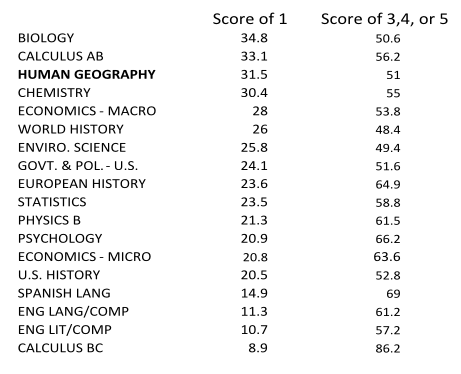
 

Taking a closer look at the scores and their distributions, one can make the broad claim that results in the social sciences are fairly mediocre.  To be sure there is a selection bias at work as well: completing the coursework for Calculus BC implies mastery of the material in Calculus AB, and the scores reflect that very few bumble through that progression.  (Full disclosure: I was one of those bumblers racking up a “2” in AP Biology many moons ago.)

Cause for hand-wringing despair?  Maybe not.  More plausible to me is the suspicion that for those taking AP Human Geography as a junior or senior in high school, it’s most likely their first exposure to thinking geographically in any kind of a structured manner. If anything, it’s a call for more rigorous geography at all grade levels as analyzing one’s place in the world and the interrelationships with those near and far is too important to leave to a cram course at the end of high school.

Add that to the wisdom lost from back in Grandmom’s day that we so need to recover, 100 years later.

 
—Brian Timoney

 

GIS, IT, and the Interests Served by a Dysfunctional Status Quo

Last week I had the pleasure of speaking at the FOSS4G Conference here in Denver, Colorado.  As has been noted elsewhere, it was a high-energy event loaded with quality technical content. With a time slot at the end of the day, I sought to change gears and speak about the role the cultural values of open source might play in an industry whose best work is too often stifled by bureaucratic intransigence and the narrow interests of entrenched vendors. While I’m proud that the vast majority in my industry are committed professionals who want to do right by their users, I am both puzzled and angered that so many projects we put in front of the public, after millions of dollars spent, fall far short of expectations.


A pleasant surprise in the aftermath of the talk was being approached by folks from the very agencies I had “called out” and being thanked for shining a modest light on the dysfunction they have been wrestling with for years. Just to be clear, the projects I highlighted weren’t chosen for being particularly egregious, but rather for being all-too-typical.

As the open source model gains traction in the geospatial industry, much ink is being spilled discussing key issues such as total-cost-of-ownership, support, security, etc.  Such scrutiny is all to the good, especially if accompanied by an equally open conversation of the benefits and costs of the status quo that all too often fails to serve users and practitioners alike.


—Brian Timoney


Letter to a College Senior

Is there anything more tedious than some middle-aged dude spewing advice to the “young people”?  Of course not.  But because I’m writing it down, you can skim-read: win/win for both of us.

That you’re going to leave school and be ejected into a crap economy is now a certainty. Rather than say “sorry”–not a wholly productive emotion, to be honest–I’ll merely observe that in our emerging Information Economy, you’ve been particularly ill-served by bits of received wisdom whose sell-by date has passed.  You reserve your constitutional right as a twenty-something to blow off anything someone more than two years older says to you, but here goes anyway:

Portfolio instead of Resume

Let’s be blunt: we loathe reading your resume as much you hate writing it. That Word doc attached to the unsolicited introductory email promises us nothing but guaranteed irritation: font choice, layout decisions, and especially the ‘objective’ blurb. Resumes are for HR, and we’re not HR–you clear on that?  Happily though, we oldsters are almost as ADD on the web as you are, so if you send us a link to something you’ve done and posted on the web, that’s different. Because you only have to command our attention for 10 seconds i.e. the time it takes for your resume attachment to open.  It can be niche (“Couldn’t afford Spring Break, so snapped geotagged iPhone shots of the different turf grasses within a mile of my mom’s house and put them on Flickr“), it can be obscure (“Check out my statistical proof that Bubby Brister is the most effective backup quarterback in the last 40 years”), just don’t be bland or predictable. The Portfolio approach enables you to display a mind engaged with the surrounding world while the Resume is an artifact specifically designed for a bureaucrat’s needs.


Statistics instead of Calculus

In 2006, about three times as many students took Calculus AP exams as Statistics AP exams.  Naturally that pays dividends down the road as the best and brightest are integrating and deriving their way to a Comfortable Life.

Actually, no.

While not dismissing the virtue of intellectual rigor, nay beauty, of Calculus, nonetheless it’s statistical reasoning gets slaughtered on a daily basis, from the front-page of the newspaper to the quarterly earnings report.  And the dirty secret of the Information Economy is that it’s largely still a Raw Data Economy: organizations have wrestled with collecting and storing data, but deriving meaningful insight from these efforts? Illusive. At best.  Armed with a semester or two of stats, an inquiring mind, and a free copy of R Studio, and you could do major damage right from the get-go. Is Stats too often the lamest class ever? Of course–but search for your inspiration. Check out this breakdown of Rory McIlroy’s dominance at the US Open using z-scores:  geeky, but very do-ably geeky, and fairly straightforward to explain to the uninitiated.  In a word, money.


Programming as a Liberal Art

In the Information Economy, the traditional gulf between Engineering and the Liberal Arts ill serves you. Again, the challenge is to see programming not through prosaic eyes as a cryptic jumble of curly brackets and odd indentations, but as a method for gathering, inspecting, and re-presenting the world around you. If you’re already have a bit of a bent in that direction, then you can already dive in courtesy of MIT.

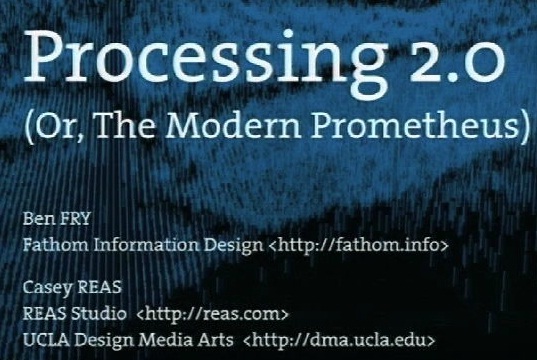
“That’s a little too technical, I’m more of a creative type.” False dichtomy: do not pass Go.  But I’ll let Ben Fry of Processing fame explain it better than I ever could:

                                       click image to go to video page--well worth it


Narrative Instead of Mere Facts

Those with the ability to intuit meaning from rows and columns of numbers work in finance: the rest of us tell each other stories. And there are those who know this too well e.g. a political discourse that cherry-picks facts only to serve the larger cause of simplistic emotionalism.  But you’re the generation that plowed through 4000 pages of Harry Potter, so you know the power of narrative as well as any. With the world ever more complicated there will be a greater need for nuance yet a greater temptation to fall back on the cheaply sentimental. Or a dry recitation of data that doesn’t convince anyone of anything. Far be it from me to insist on seeking out masters such as Chekhov and Munro, so I’ll back off and merely suggest strongly that you check out masters such as Chekhov and Munro.

 
Initiative and Experience

A mistake of youth is to engage in all manner of contortions to mimic the experience of their elders: if you’re in your 20s, no one expects you to have a ten year track-record in anything.  But what you can demonstrate is initiative. Sure, the job market is tough, but the opportunities for self-learning are unprecedented. While the college admission process in place now severely penalizes the Knucklehead Teenager, if you pull yourself together as a Motivated Young Adult, top-drawer institutions such as Stanford and MIT are giving the knowledge away. In the everyday world self-reliance and initiative are the great differentiators, not SAT scores.

OK, you have things to do; I have things to do.  Best of luck.


—Brian Timoney


* image courtesy of the ZedZaP Flickr stream